Thank you! Your submission has been received!
Oops! Something went wrong while submitting the form.
Blog post cover
Opportunity to See: The Bridge Between Playback Logs and Human Exposure
A screen plays an ad. That question sits at the heart of in-store retail media measurement. And "Opportunity to See", OTS, is the industry's attempt to...
Blog post cover
Taxonomy and SKU Mapping: The Hidden Plumbing of Retail Media Truth
Nobody wants to talk about taxonomy. It doesn't make good slides. No brand manager has ever said "I'm thrilled about the SKU mapping." But taxonomy is...
Blog post cover
Predictive Audiences: When Retail Media Moves From Segments to Probability
Predictive audiences target shoppers by purchase probability, not past behavior. Segments to scores: more precise, less waste.
Blog post cover
Verified Impressions: The Difference Between Served and Proven
Served impressions log system activity. Verified impressions prove a human had a real chance to see the ad. The gap defines retail media trust.
Blog post cover
Retail Signals: The Raw Material That Makes Retail Media Perform
Every media channel runs on data. Digital runs on clicks and cookies. TV runs on panels and surveys.
Blog post cover
Category Affinity: The Shortcut to Relevant Targeting
Category affinity targets shoppers predisposed to your brand based on real purchase data. The fastest path to relevant targeting in retail media.
Blog post cover
True Reach: What Reach Actually Means
in Retail Media Impressions are not reach. It isn't, because most retail media reports treat them as the same thing. A screen plays an ad 10,000 times in a week...
Blog post cover
Sponsored Products: Retail Media at the Moment of Choice
The shopper has typed "breakfast cereal" into the retailer's search bar. They're on the website or the app. They're in buying mode.
Blog post cover
Occasion Frequency: How Often the Moment Happens Per Shopper
Occasion frequency turns behavioral insight into a budgetable media plan. How frequency profiles shape planning, creative rotation, measurement, and commercial sizing.
Blog post cover
Match Rate: The KPI That Limits Retail Media Proof
Match rate is the percentage of exposed shoppers who can be identified in the retailer database. It sets the ceiling on attribution, control groups, optimization, and audience precision.
Blog post cover
Audience-Based Buying: The Future of Retail Media
Audience-based buying marks a structural shift in retail media — from selling inventory to delivering outcomes. Instead of focusing on where ads appear, this approach focuses on who they reach, when they are reached, and what behavior changes as a result.
Blog post cover
Shopping Occasions: Behavior Patterns as Campaigns
Shopping occasions are the recurring moments that shape how and when people buy — from quick weekday breakfast runs to weekend indulgence or party purchases. Unlike broad audience segments, these patterns are visible in real transaction data and repeat over time, making them predictable and actionable.
Blog post cover
Closed-Loop Measurement: Proving Sales Impact
Closed-loop measurement is the foundation of retail media, connecting ad exposure, shopper identity, and transactional data within a single unified system. Every campaign links who saw the ad to what they bought, proving whether the media drove real sales, not just impressions.
Blog post cover
Onsite vs Offsite Retail Media: Where Each Works
Retail media campaigns operate across two territories: onsite and offsite. Onsite media reaches shoppers inside the retailer’s ecosystem, including stores, websites, and apps, where purchase intent is already high and conversion rates are strongest. Offsite media reaches shoppers across the open web, social media, and streaming platforms using retailer first-party data to build awareness before the shopping trip begins.
Blog post cover
Life Stage Segments in Retail Media Targeting
Life stage segments are more useful than demographics in retail media targeting. Retailers can infer life stage from transaction data, basket patterns, category entry, shopping frequency, and behavioral change over time. Life stage targeting improves relevance, opens cross-category opportunities, predicts future needs, and creates premium audience products for retail media networks.
Blog post cover
Holdout Groups: Retail Media's Cleanest Incrementality Test
Control groups are the most reliable method of measuring incrementality in retail media. By comparing exposed and unexposed shopper groups, the true effect of a campaign can be isolated, which is why this method is considered the gold standard for causal proof, and how it works alongside demand forecasting models.
Blog post cover
4 Pillars Every Retail Media Network Needs
A real RMN is not just a website ad slot, in-store screen, or loyalty data product. These four pillars every RMN must include to be credible and scalable: connected inventory across the shopper journey, first-party data signals that power targeting, proof through closed-loop measurement and incrementality, and an operating model that turns retail media into a repeatable business.
Blog post cover
Retail Media Baseline: The Starting Line for Uplift
Why it is essential to define the right retail media baseline for accurate measurement, and how forecasting models and control groups can reveal the true retail media uplift and incremental sales impact
Blog post cover
The Basket Brand Influence Graph
In the shopper’s mind, there’s no category chart or brand hierarchy. There’s just a basket. People don’t buy in isolation, they buy in patterns. A beer often comes with snacks. Pasta brings sauce. Diapers pull wipes. These patterns reveal invisible relationships between brands and when you map them, something remarkable appears: a living network of influence inside every store.
Blog post cover
What Promo Elasticity Really Tells You
The new rule of promotions: Don’t chase volume. Chase responsiveness. Because when you understand elasticity, you don’t just run promotions, you orchestrate them. Footprints AI can predict when a discount becomes a decision trigger at shopper level.
Blog post cover
Shopping Missions: Missing Context in Media Planning
Shoppers don’t just enter a store as “female, 32, urban.” They enter with a purpose. Stocking up. Grabbing something urgent. Preparing for a celebration. That purpose is what defines relevance. And that’s what Shopping Missions reveal: the why behind every basket.
Blog post cover
RFM Segments: Measurable Shopper Growth
Retail media wins by growing shopper value, not just impressions. RFM segmentation (Recency, Frequency, Monetary) provides the framework to identify who your best shoppers are, who is slipping away, and where the growth opportunity sits. This is how media plans move from targeting to value creation.
Blog post cover
NTB (New to Brand): The Metric That Proves Growth
Most retail media metrics tell you what sold. New to Brand tells you who you gained. It measures first-time buyers within a defined window, proving whether your campaign expanded the customer base or just recycled existing loyalty. This is the metric that separates growth from noise.
Blog post cover
Household Penetration: Foundation for Brand Growth
Household penetration measures how many families are choosing your brand for the first time. In retail media, this metric turns one-off campaigns into sustained growth by tracking how many new homes your product reaches, not just how many units you sell to the same buyers.
Blog post cover
Basket Incidence: Tracking How Retail Ads Change Habits
Basket incidence shows how often your product appears in a shopper's basket. It is the most direct measure of whether a retail media campaign is changing purchase habits, not just generating impressions.
Blog post cover
How Category Entry Points Supercharge Your Retail Ads
Simple idea: people don’t buy categories; they enter them. Category Entry Points (CEPs) are the cues (moments, needs, places, companions) that put a shopper in-market now.
Blog post cover
Footprints AI Wins IAB Europe MIXX Award 2025
Retail Media made history: Footprints AI, Intersnack's Chio Chips, and Profi (Abold Delhaize) won the first IAB MIXX Retail Media Award for an AI-driven omnichannel campaign that outperformed traditional advertising.
Blog post cover
How a Summit in Bucharest is Reshaping Global Commerce
The first Retail Media Summit in CEE by Footprints AI explored the future of Retail Media, AI, and data-driven advertising, unveiling strategies for audience monetization, AI-driven personalization, and omnichannel integration.
Blog post cover
Why 8 Out of 10 Retail Media Initiatives Fail
Why 8 out of 10 Retail Media initiatives fail, despite the promise of Retail Media to represent up to 35% of retail earnings by 2030? The main reason is not rooted in retail operations, but in the media strategy.
Blog post cover
In-Store Sponsored Products: A Retail Media Twist
Footprints AI is pioneering a new era of Retail Media, where the value of in-store advertising is maximized through precise targeting and personalization.
Blog post cover
In-Store Digital Advertising: The Next Leap
The future holds an exciting promise of transformation in how brands connect with their consumers. It’s been 22 years since The Minority Report movie came out, and in 2024 its vision of personalized in-store advertising has become more reality than fiction.
Blog post cover
Premiumisation: The Future of Retail Media Networks
Retail media faces a crucial battle against digital giants like Google and Meta for brands' advertising budgets. Premiumisation is the strategy that transforms retail media networks from commodity ad sellers into premium data-driven platforms that command higher CPMs through precision and proof.
Blog post cover
How Malls Make Money: Leasing to Retail Media
Malls have relied on tenant rent, percentage leases, and marketing fees for decades. But the next revenue frontier is Retail Media: monetizing first-party shopper data through targeted advertising that commands premium CPMs and transforms malls into media platforms.
Blog post cover
How Retailers Make Money: Profit Strategies in 2026
The future of retail profitability lies in embracing diversification and leveraging the power of data and AI. The convergence of traditional retail and tech-first strategies will shape the retail landscape.
Blog post cover
Recommendation AI: Personalized Product Suggestions
In the future of physical retail, Recommendation-Type AI stands as a pivotal force. By providing real-time personalized recommendations, it elevates the shopping experience and serves as a catalyst for increased sales and customer satisfaction.
Blog post cover
AI's Role in Personalizing Your Shopping Journey
Imagine this: you walk into a store, physical or online, and every product seems handpicked just for you. That's right. No more hours of scrolling through pages or aisles to find what you need. This isn't a fantasy; it's the future of shopping, and it's closer than you think.
Blog post cover
Retail Media and Autonomous Stores: A Guide
Retail Media and autonomous stores are a match made in heaven, changing the way we shop for the better. Footprints AI is leading the charge in this exciting retail revolution, offering a comprehensive solution for retailers looking to embrace the future.
Blog post cover
Showrooming Impact on Retailer Online Performance
Showrooming data proves that physical store visits drive online sales. Footprints AI measures this cross-channel impact, giving retailers and brands evidence that in-store presence fuels digital performance.
Blog post cover
Beyond Trade: Driving 50% of Retail Profits by 2030
By 2030, 'beyond trade' activities such as Retail Media Networks, data monetization, and marketplace platforms will drive up to 50% of retailer profits. This shift from traditional margins to data-driven revenue is transforming how retailers create value from their most underused asset: shopper behavior data.
Blog post cover
AI: The Bridge Between Physical and Digital Retail
AI bridges the gap between physical and digital retail by connecting shopper behavior across channels. The Halo Effect and Retail Gravitational Pull explain why physical stores drive online sales, and Footprints AI codifies these theories into actionable Retail Media strategies.
Blog post cover
Predictive AI: Forecasting Shopper Behavior
Prediction is the key to proactive decision making in retail. Predictive models in AI technologies allow businesses to anticipate future trends and events, giving them a competitive edge.
Blog post cover
Categorization AI: How ML Classifies Shoppers
Categorization AI classifies shoppers into behavioral segments for targeted Retail Media campaigns. By analyzing movement patterns and purchase data, retailers can group customers into actionable audiences.
Blog post cover
Classification AI: Sorting Shopper Behavior Groups
Classification AI sorts shopper behavior patterns into actionable groups for Retail Media targeting. By identifying distinct behavioral profiles, retailers can deliver relevant campaigns to each segment.
Blog post cover
Indoor Location Intelligence for Physical Retailers
Indoor location intelligence tracks how shoppers move through physical stores. This data powers Retail Media by enabling screen-level impression delivery, zone-based audience targeting, and path-to-purchase measurement that connects ad exposure to purchases.
Blog post cover
Priming: Using AI to Target Pre-Shopping Moments
Priming is the psychological principle that pre-shopping exposure influences purchase decisions. In Retail Media, AI-powered priming means reaching shoppers with the right message just before they enter the store, when receptivity to brand messaging is highest.
Blog post cover
Why US Shopping Malls Are Declining and What Comes Next
US shopping malls face declining foot traffic and rising vacancies. But their most valuable asset, millions of shopper visits generating behavioral data, remains largely unmonetized. Retail Media Networks offer a new revenue stream that transforms this data into targeted advertising.
Blog post cover
5 levels of practical AI for every retail owner
AI, as a field of computer science, is transforming retail by enabling smart machines to perform tasks that previously required human intelligence, leading to a highly convenient and disruptive retail experience.
Blog post cover
From Omnichannel to Omni-Experience
The next evolution in retail goes beyond omnichannel logistics to omni-experience: seamless shopper journeys that blend physical and digital touchpoints. Retail Media plays a central role in orchestrating these unified experiences.
Blog post cover
The Halo Effect and retail gravitation
The Halo Effect shows that physical stores drive online sales, and retail gravitation theory explains why shoppers cluster around larger retail centers. Both concepts are foundational to understanding why in-store Retail Media campaigns create measurable impact across channels.
Blog post cover
Predictive Behavioral Modeling for Shoppers
Predictive behavioral modeling uses machine learning to forecast shopping patterns. In Retail Media, these models power predictive audiences, shopping occasion targeting, and campaign timing that reaches the right shopper at the right moment.
Blog post cover
Retail Media Recipe: Drive In-Store Traffic
Driving store traffic is the most fundamental retail media objective. This recipe shows how to build campaigns that convert media impressions into measurable store visits, using audience targeting and location-based activation.
Blog post cover
Retail Media Recipe: Increase Cross-Shopping
Cross-shopping is when a shopper visits or buys from multiple categories or stores in a single trip. This recipe shows how retail media campaigns can expand basket composition and drive category penetration.
Blog post cover
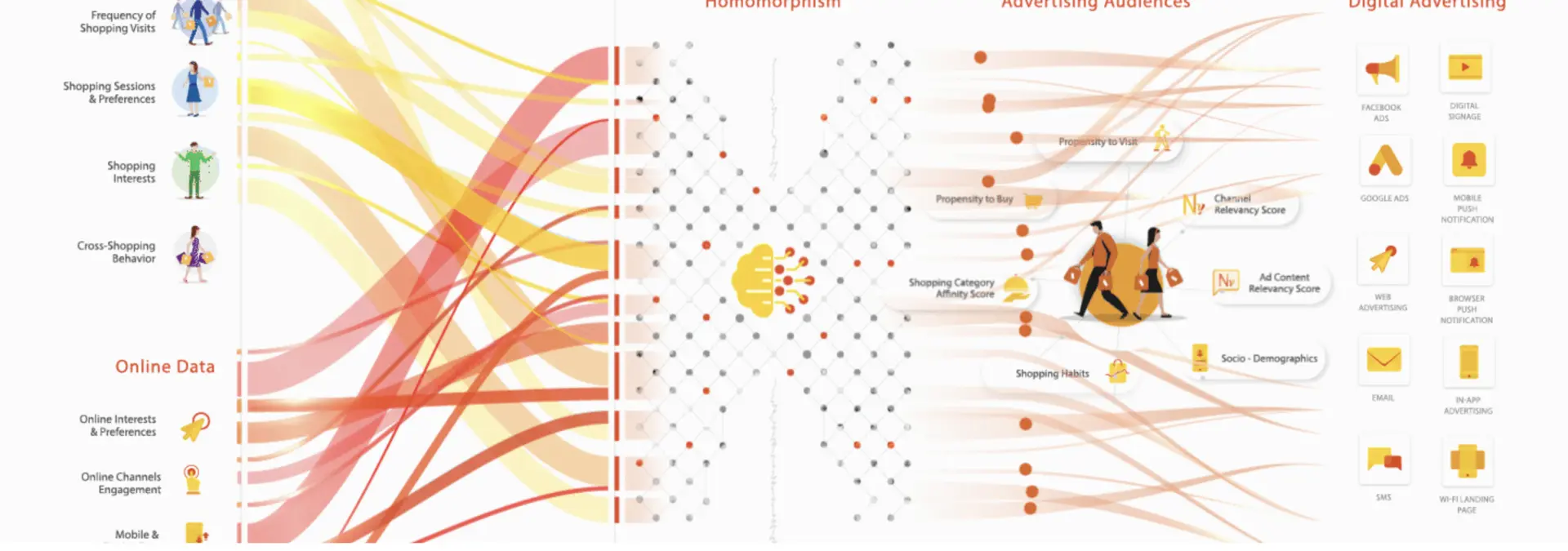
Homomorphism: How Footprints AI Differentiates
Homomorphism is the mathematical principle that enables Footprints AI to match shopper audiences across datasets without exposing personal data. This privacy-safe approach to Retail Media targeting lets retailers activate first-party data while maintaining full compliance.
Blog post cover
Retail Media Recipe: Increase Visit Duration
Longer visits mean more exposure, more categories explored, and larger baskets. This recipe shows how retail media campaigns can increase dwell time by targeting shoppers with contextually relevant messages during their trip.
Blog post cover
Retail Media Recipe: Boost Event Attendance
Retail media can drive event attendance by targeting the right shoppers at the right time. This recipe shows how to build campaigns that turn store events into measurable traffic and engagement opportunities.
Blog post cover
Footprints AI Now on Microsoft Azure Marketplace
Footprints AI listed its Retail Media operating system on the Microsoft Azure Marketplace as a Preferred Solution, bringing AI-powered shopper intelligence, predictive analytics, and campaign automation to physical retail worldwide.
Blog post cover
Footprints AI: Retail Media for Physical Retail
Footprints AI is the Retail Media platform that brings AI-powered audience targeting, omnichannel campaign delivery, and closed-loop sales measurement to physical retail.
Blog post cover
Retail Media Recipe: Measure Visitor Satisfaction
Choosing the right campaign objective is the first decision in any retail media plan. This guide walks through how to define measurable goals that connect media spend to real shopper outcomes, from awareness to conversion.
By clicking “Accept All”, you agree to the storing of cookies on your device to enhance site navigation, analyze site usage, and assist in our marketing efforts. View our Privacy Policy for more information.
Thank you! Your submission has been received!
Oops! Something went wrong while submitting the form.